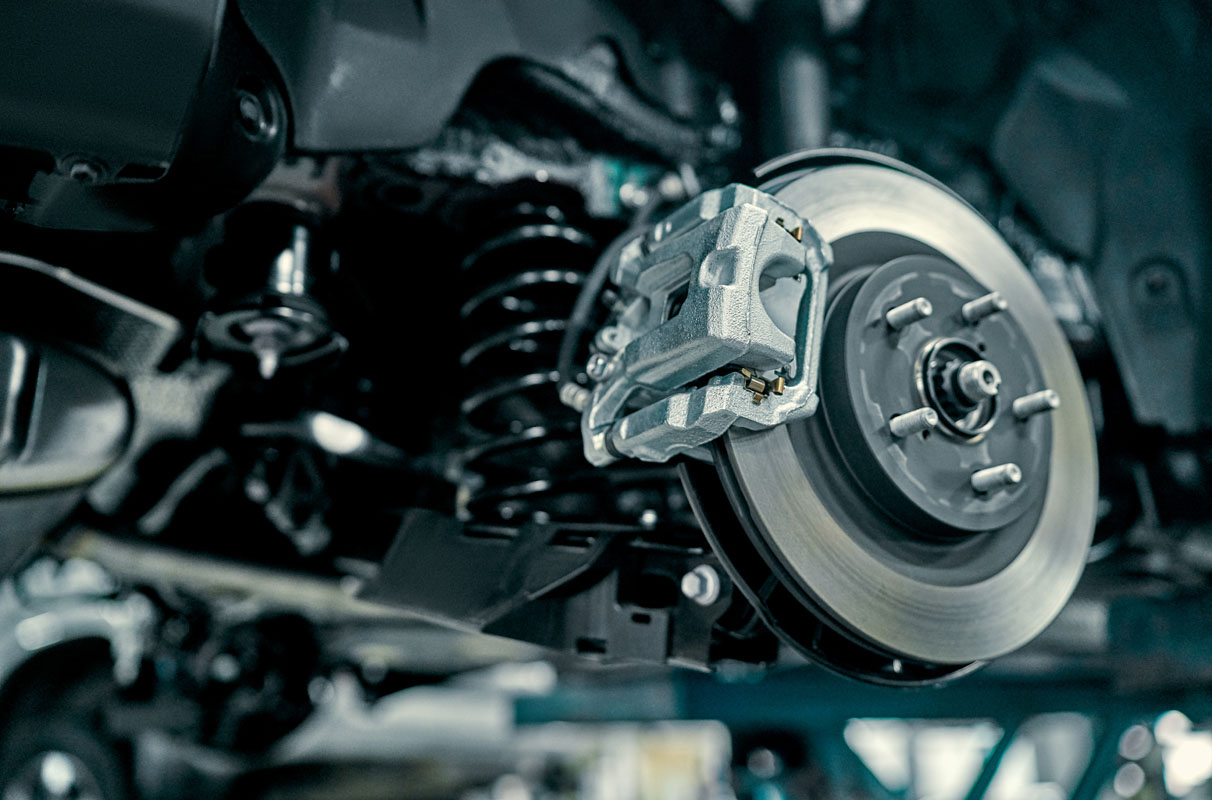
If you notice any of these five warning signals, have an auto shop to replace your worn brake pads sooner than later.
Signs You Need New Brake Pads
1. You Hear a Squealing Noise.
Think of this: You’re driving around town with the radio off and your windows up. In the “somewhat” quiet, you hear a vague scraping, squealing, or buzzing noise. You also notice that, anytime you depress the brakes, that obscure noise disappears, only to come back once you depress the brake pedal. What’s happening?
Presently, most—but not every—brake pads are manufactured with fundamental “wear indicators.” The initial intention behind these indicators is to give off that unenjoyable screech you’ve just heard. These wear indicators are metal tabs situated near the top of common brake pads. As the brake pad wears down to a severe extent, the indicator is going to scrape against the rotor. This is going to create an uncommon grating sound which in turn, is going to warn the driver that their current brake pads are susceptible to eroding away completely.
2. You Hear a Clicking Noise.
In a lot of vehicles, the brake pads are going to fit snugly into a specialized holding device. Other vehicles keep them stable with pins clips, or bolts. At any rate, the common objective behind these designs is to stop the brake pads from shaking around. If they become loosened in some way (maybe after a part of the surrounding hardware gets impaired), they are going to begin to shake. What then happens is a clicking noise that is emitted whenever the brake pedal is pressed or depressed.
3. Bringing The Vehicle to a Stop Takes More Time Than Usual.
This issue has a term and that term is “brake fade.” Most commonly it’s the direct outcome of purposely depressing the brakes over a substantiable distance without bringing the vehicle to a complete stop. Every now and then, such a maneuver might be required, especially when driving down a steep hill or over a twisting road. Nevertheless, if this is something you do often—like if you live in a hilly location in which you must routinely drive downhill—it is going to have a negative impact on your braking system after a while. Forcing the brake pads to contact the rotors for an extended, non-stop period, both components are going to heat up. Therefore, their ability to generate required friction against each other decreases over time. Because of that, you are going to find that your vehicle is not going to come to a complete stop as swiftly as usual.
4. The Front of Your Vehicle Pulls to One Side When Braking.
Your vehicle’s brake pads are not always going to wear out at precisely the same rate. Often, those on one side are going to get thinner quicker than their equivalents on the other side of the vehicle. Should this happen, the vehicle could pull slightly to one side once you depress the brakes. Leave the issue unchecked, and you are going to put unneeded strain on your steering rack (additionally to your vehicle’s ball joints, wheel bearings, and steering knuckles). Don’t take a chance: Have a mechanic investigate the problem as soon as possible.
Don’t forget that brake pads might not completely be the cause behind this particular issue. It might also stem from such other issues like uneven tire pressure, faulty wheel bearings, or a failing brake caliper. Having said that, if irregularly worn brake pads are really to blame, two new sets need to be installed in one go around.
5. Vehicles Brake Pedal Vibrates When Depressed.
Does the brake pedal severely shake when stepping on it? Your brake pads could be the cause of the issue. Brake pads are usually held together with a sort of binding resin. As they wear down, the resin gets hot and gets coated across the rotor. Under perfect settings, it is going to form a coating that is evenly spread across the disc’s surface. However, if a brake pad happens to get overheated, the resin might not be spread out evenly. Automotive technicians call this issue “glazing” and it can be the cause of brake pedals vibrating.
A vibrating brake pedal is not a dependable one. If the issue goes disregarded, your ability for braking safely could be in jeopardy. In regard to brake-pad maintenance, stay safe and don’t hesitate to have them checked.
Land Rover Repairs By Rov-N-Techs In Scottsdale, Arizona
Rov-N-Techs performs all factory recommended services on Land Rovers & Jaguars at affordable prices! Master Technicians, Joe Caraway and Kevin Curtis worked at Land Rover of North Scottsdale for 10 years before opening their own shop in 2006 under the name of “Rover Techs”. Now known as “Rov-N-Techs” Joe and Kevin offer over 35 years of combined Land Rover experience. Contact us today!